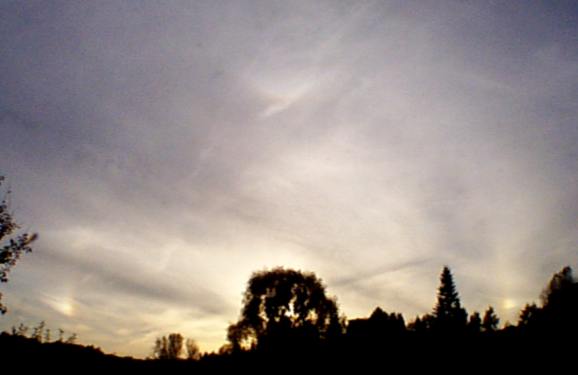
This is an example of a striking display of a halo, parhelia and some arcs which was seen from Tervuren in Belgium on 30th October 1999. There was a very thin layer of high cloud over most of the sky and as sunset approached the display became increasingly pronounced. The main sun dogs were very bright and had to be under exposed to capture the strong colours which were visible to the naked eye. There was also a white circular light arc around the sun with a darker zone between this arc and the sun itself. By hiding the sun behind a tree I was able to get a reasonable set of images showing the overall view and the main components in close-up.
This image was taken with a wide angle attachment on a DC120 digital camera and shows the full extent of the display with a 22 degree arc, the mock suns to left and right of the sun and a an upper contact arc.
 |
The upper contact arc could be easily overlooked, and varied in strength during the display. At its brightest it was very colourful and appeared roughly parabolic in shape. It is concave upwards. I failed to get a decent image which showed the spectrum visible to the naked eye. This is the closest I got. The clouds are not uniform and the brightness varied as the clouds drifted by. The diagonal white line is a aircraft con trail. |
 |
The left parhelium was very bright and intensely colourful with red shading to yellow nearest the sun and bluish on the outside. There was a radial tail outwards away from the bright zone The central zone was blinding white and made photography difficult. The cloud is much thinner than it looks in these pictures - they are deliberately underexposed to retain detail and colour information in the brightest region. |
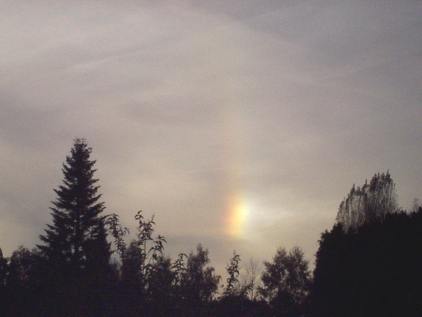 |
The right parhelium was not as bright at it's southerly twin, but made up for this by having a much brighter 22 degree circular halo visibly connected to it. Inside the halo was darker than outside, although this doesn't show on my image here. There was also a radial white light horizontal tail from the brightest zone away from the sun. |
There is a lot more useful information about atmospheric optical phenomena and halo displays on Les Cowleys Atmospheric Optics web site, including a wonderful halo simulator program which allows you to generate model displays.

