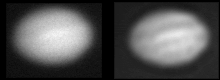
These are some preliminary results with a Maximum Entropy program I am developing in spare moments. The raw image J24 on the left was provided by Ken Irving of Salford Astronomical Society taken with an early Starlight eXpress framestore camera. Unfortunately the seeing in Salford is rarely very steady so even with short CCD exposures the results are often blurred. Deconvolution was done using a Gaussian blurring function estimated from a Galilean satellite which was faintly visible in the field of view.
Purists may well cringe at the idea of blind deconvolution where the point spread has been estimated in such an ad hoc and empirical way, but the results show that the approximations are worthwhile. The deconvolved image is roughly 3x sharper in linear angular resolution. I hope to have some more controlled comparisons in the future.
Original image J24-1 barely shows the equatorial belts, but when deconvolved shows some belt detail.
The image is a GIF original is on the right and the one on the left is compressed with GIF Lite.
I don't think GIFLite has done any harm to its appearance and saves 50% space, but I would appreciate feedback. The noisy nature of the raw data and the need to avoid adding JPEG artefacts to the deconvolution has required me to save these as GIF files. I will eventually make the program available as shareware, but for the moment it is still very much an experimental version for my own use.

