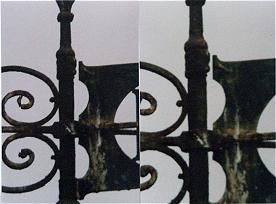
4300mm f17
2x +21mm extension
5500mm f22
2x +34mm extension
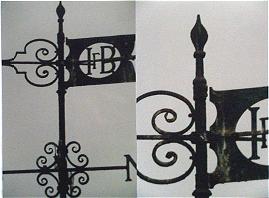
1600mm f6.3
3200mm f12.6
2x converter

1040mm f4
x0.6 compressor
880mm f3.5
x0.6 compressor
+ 31mm extension
Using teleconverters and telecompressors with SCT's can allow a reasonable range of magnifications to be obtained by varying the spacing behind the teleconverter with extension tubes and using the long range of focus adjustment inherent in these designs. The following shots were taken on Fujichrome 100ASA 35mm film using an f6.3 LX200 of nominal focal length 1600mm. The teleconverter was a Pentax k 2x and the telecompressor was a Meade 0.6x unit (intended to be used with f10 scopes). The target was a weather vane on the village hall which serves as a nice high contrast target.
On an SCT which has an amazing range of focus adjustment it is possible to get magnifications from x2 to x3.4 from an ordinary Pentax 2x teleconverter (or x3 to x4.5 from a 3x) and 0.6 to 0.55 from the Meade telecompressor. It is distinctly counter intuitive that adding extra length behind a telecompressor increases the compression ratio but it follows from the mathematics. The compressor gives a vignetted field less than 12mm across which is really only suitable for CCD work as the effect is obtrusive on a 35mm slide.
One of the nice things about teleconverters is that they are optimised for projecting an image onto a flat film plane and although they only give modest magnifications it can still be useful for lunar photography. I would like to obtain an old Pentax k bayonet 1.4x teleconverter for further experiments.
|
x2.7 4300mm f17 2x +21mm extension |
x3.4 5500mm f22 2x +34mm extension |
|
x1 1600mm f6.3 |
x2.0 3200mm f12.6 2x converter |
|
x0.65 1040mm f4 x0.6 compressor |
x0.55 880mm f3.5 x0.6 compressor + 31mm extension |
Although the vignetting is apparent in both the telecompressed images the central zone is usable. The telecompressor is not really intended to be used with f6.3 scopes but I think it works pretty well even so.
The SCT design consists of a fast primary mirror and a convex secondary which makes exact computation of magnifications somewhat tricky. I decided therefore on this empirical test of the range of possible zoom. I could not focus the image properly with 44mm of extension used, but it was pretty close and might work on other units.
An approximate empirical fit to the use the converters with extension tubes of length D mm is:
Magnification = 2 + D / 30
Compression = 0.65 - D / 300
It is possible in principle to obtain an accurate formula in terms of the primary and secondary mirrors and the effective focal length of the modifying lens, but the expressions given above are close enough to be useful.
It would be interesting to know what range is possible with other telescopes.

