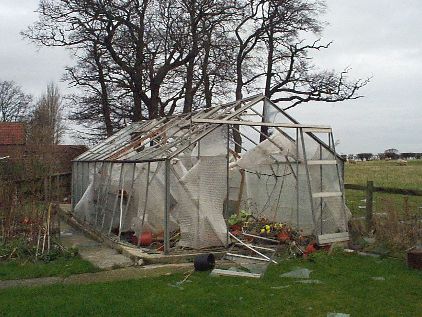
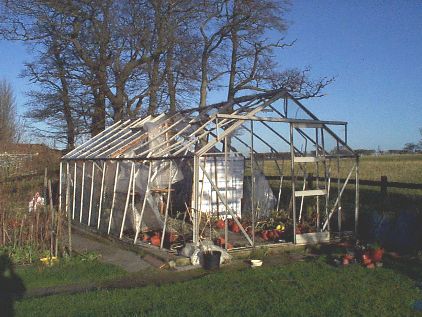
Greenhouses are always vulnerable to occasional panes of glass breaking. This is bad enough in a cold greenhouse, because wind inside the structure can do a lot of damage. But in a heated one you don't want the heat to escape and the plants to suffer. Accordingly I always keep a few pieces of hardboard, Perspex and twinwall polycarbonate sheets ready to patch up damage and slot into gaps at a moments notice. This has saved me from trouble in all but the storm of Xmas 1997 where the windspeed gusted to almost 100mph and I knew it was a lost cause. The aluminium struts in the most exposed corner of the greenhouse roof buckled inwards and then once the wind got into the structure the bubble wrap insulation acted like a sail. Sheets of glass and one greenhouse door was lifted high into the air and it was unsafe to approach until the storm had died down the next morning to inspect the carnage. The wind loading with the bubble wrap and extreme winds eventually wrenched the corner facing into the wind off its foundations. More than half the glass disappeared into the neighbouring field some of it coming down in jagged shards over 60' away.
|
|
| The morning after the storm. Massive loss of glass frame badly distorted | After making safe broken glass and rebuilding the warm end. |
Wind was blowing left to right. It proved impossible to repair since everything was warped, twisted and buckled by the immense force of the wind.
A few things became obvious after inspecting the damage:
The aluminium clips I used to hold down the roof vents in storm conditions worked perfectly. They were all still shut.
The main damage occurred where the greenhouse faced directly into the wind. This suggests that you might be able to improve survival of a normal greenhouse by fitting stronger aluminium bracing struts on the corner facing into the prevailing wind direction. The initial failure started there.
The doors are another weak point especially once the wind gets inside the structure. Fitting some form of locking system to prevent the wind lifting the doors outwards would have prevented a fair amount of damage to the door end of the greenhouse.
A few panes of glass fail to flying debris every winter but this disastrous storm was something else. However, even though they were no use in this instance. My quick repair greenhouse panel has proved invaluable in all previous wind damage. The idea is to keep a few pieces of material ready complete with instant fastening so that if a panel of glass fails you can do an immediate repair before any secondary damage can occur. The panel should be cut to size ready for use and then prepared with a fixing baton and a couple of metal hooks ready to insert and lock into place. The hooks might not be necessary if you can always guarantee being able to slot the material in underneath the sheet of glass/support above it.
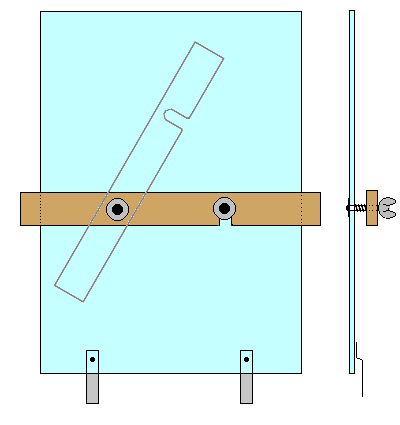 |
The idea is to arrange a wooden baton roughly 5cm x 2cm and 8cm
longer than the gap between your greenhouse glazing bars. Two bolts are
fitted though the sheet and baton with wing nuts on so that it will fit
easily through the gap in the greenhouse and clip on to existing glass
below. Once in position the baton falls to the horizontal position
temporarily holding the sheet in position while you go inside and
tighten the wing nuts to lock it in place. This trick can also be used to permanently mount twinwall polycarbonate sheet or Perspex sheet into a greenhouse frame. Though for a permanent fitting you probably want a thinner stronger aluminium strut rather than wood. For a very large sheet you will need two batons to hold it in at top and bottom. I have used this with hardboard, marine ply, Perspex and twinwall polycarbonate. The plastics sheets need a bit of care with large washers and large headed screws to spread the load. |
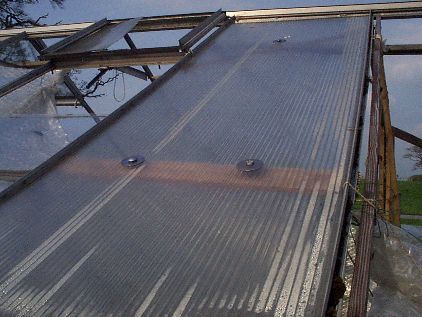
One of the few undamaged parts of the greenhouse was the experimental twinwall panel at the warm end of the greenhouse. I had planned to replace all the glass in the heated section with twinwall. This shows how the fixings work in practice on a large 2m x 60cm sheet of 1cm thick heavy duty twinwall. The twinwall has much better insulation properties than glass and bubblewrap. The 6mm twinwall material is inadequate for greenhouses and will flex too easily.
I hope these notes help others to avoid serious damage to their greenhouse. The one thing that is crucial to remember is safety first. Flying glass can be incredibly dangerous and at the height of the storm you don't want to be anywhere near a collapsing greenhouse.

