Light Pollution Additional Notes
Martin Brown, 20thOctober 2003
The recent select committee report on light pollution and astronomy recommended replacement of all existing orange low pressure sodium lamps (LPS) with new full cut off or partial cut off white high pressure sodium lamps (HPS).
I believe that this recommendation to use only HPS lighting in the future is misguided.
The light source isnot the main problem but the design of sensible FCO luminaires is.
The review notes that some astronomers prefer LPS (para #75, p28) but then goes on to say that the majority prefer HPS without establishing whether this preference is based on sound reasoning or prejudice against “nasty” orange skies. It is no coincidence that LPS lamps in FCO fixtures are mandated for the regions around major optical observatories. This is even mentioned in other evidence cited in the report e.g. Bisei, Japan p59.
I believe that dimmer orange skies would be more environmentally friendly and much more astronomer friendly than the proposed replacement with expensive slightly dimmer grey skies. If the orange skies are dim enough they will be below limit for photopic (colour) vision.
Fundamentally the problem for astronomy with HPS is that the light is broadband and white. There is no way to distinguish it from the white light from faint stars and galaxies.
There is also an energy efficiency argument for LPS. LPS lamps are so very efficient that even when 30% of the light goes directly upwards they still useless energy than HPS to put the same amount of light on the ground. This sounds odd but LPS holds the record for efficacy by a wide margin and is roughly 2x more energy efficient than HPS.
It also explains the discrepancy between the predictions of potential energy savings from ILE and those of BAA/CPRE (Para 91, p31). There will be little or no energy saving realised. Installing new lighting systems that are only half as energy efficient is a retrograde step.
Here is a rough calculation for lumen output of a nominal 100W lamp in various luminaires:
|
LPS (unshielded) |
LPS (full cutoff) |
HPS (unshielded) |
HPS (full cutoff) |
|
|
Total light |
20000 |
20000 |
10000 |
10000 |
| Upwards |
6000 |
800 |
2000 |
400 |
| Downwards |
14000 |
19200 |
8000 |
9600 |
| Reflected up |
1400 |
1920 |
800 |
960 |
| Net upwards |
7400 |
2720 |
2800 |
1360 |
| Percentage as Light Pollution |
37% |
14% |
28% |
14% |
| Filter factor |
1/200 |
1/200 |
1/10 |
1/10 |
| Net contribution |
0.2% |
0.1% |
2.8% |
1.4% |
Unshielded LPS in old fixtures are bad and send a high percentage of light directly skywards.
But once you fit reflective full cut off shielding the light source is irrelevant. These fixtures are common on the continent but are virtually unknown in the UK. The net result is that LPS are twice as bright for the same power or need only half the power for the same brightness.
Replacing highly efficient existing LPS units with FCO HPS lighting could require a 40% increase in power consumption to maintain the existing levels of street illumination.
But if modern LPS fixtures with FCO shields and/or a retrofit programme for existing LPS luminaires were to be adopted we would have genuine energy savings and/or brighter streets.
The reflectivity of the ground means that at least 10% of all light from streetlamps eventually will find its way up into the sky. That contribution can only be successfully filtered out if it is a narrow line emission like LPS. By using HPS we will have opted for perpetual moonlight.
Filters are available that completely eliminate the brightness of the LPS yellow sodium D-lines –although the optimum astronomical filter attenuates it by about a factor of 200.
The best filters for broader band HPS light struggle to obtain a factor 10 improvement and the spectrum of HPS emission includes a bright turquoise line at about 500nm that is inside the narrowest passband nebula filters like OIII available to amateur astronomers.
What do these reflective baffles for LPS look like?
The simplest version is an aluminium cylinder of radius 2r wrapped around the long bulb. The key is to reflect most of the waste light that would otherwise go skywards back down onto the road at about 1-2 pole heights away. Here is an illustration of the typical geometry for a simple family of reflector curves based on the simplest cylindrical designs. This design places a cylinder radius R at a distance R/2 from the closest surface of the luminous tube.
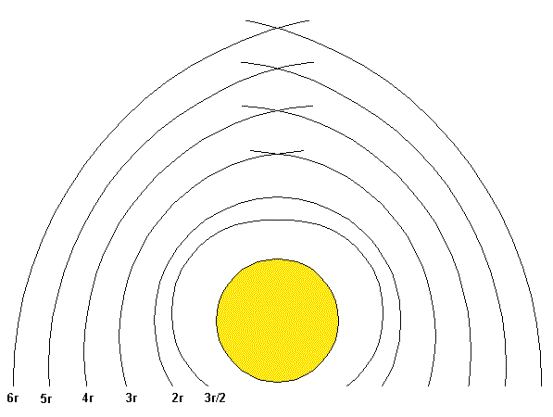
Figure 1: Family of simple partial cylinder reflectors around an LPS lamp of radius r.
The intention of this design is to redirect light back downwards in a beam at about 45 degrees so that it spreads it effectively into the region between adjacent lampposts. Larger reflectors provide better directional control but a larger physical size.
The width and height of a 6r FCO enclosure for LPS is similar to that of an FCO HPS design.