Submission to the Select Committee on Light Pollution and Astronomy in the UK
By Martin Brown, Nezumi Scientific Software
I am a long time amateur astronomer and former radio astronomer. I have an interest in control of light pollution from the perspective of amateur astronomers and in filters and luminaire designs that can help to reduce the problem. I should declare an interest here, my own Nonad photographic filter is one such doped glass filter, Baader planetarium also sell a Neodymium filter effective against LPS, and Orion Optics (UK) make a visual Sodium light interference filter effective against mixed HPS/LPS lighting.
I will include some background material as well as web references to material in US light pollution statutes that may provide a useful model. The questions that I feel able to address are as follows.
Impact of light pollution on UK astronomy ?
It is now difficult to get away from light pollution anywhere in the UK. The level of street lighting and the increasing move to illuminate all road junctions on major roads makes it very difficult to find truly dark skies. Long photographic exposures even in good conditions suffer from scattered light from nearby cities up to 20 miles away (or more). Professional optical astronomy is now limited to doing experiments that are possible under light polluted conditions and testing equipment for use overseas.
Light pollution is itself perhaps something of a misnomer. ?Wasted light? would be a less emotive description ? light that goes directly into the sky would be valuable if it were reflected downwards.
Is it measurable in such a way as to be legally enforceable?
It should be possible to measure and in many cases determine by simple visual inspection whether or not a particular design of luminaire will be sky friendly or not. The vast majority of the UK street lamps are by design sending a significant proportion of their light skywards. This is inefficient.
It could even be partly resolved by retro fitting relatively simple designs of reflector into old lamps. The simplest designs of reflector need be no more complex or heavy than aluminium pie trays.
There are some clearly measurable properties of luminaires.
- Power consumption.
- Total light output.
- Proportion that is wasted.
- Spectrum of the light.
The aims for astronomy are:
- Use the minimum amount of light needed for the task in hand
- Minimise the amount of light that goes upwards above the horizontal
- Use only light which can be relatively easily filtered out at the telescope.
A lot of commercial properties are significantly over lit because it is believed (perhaps correctly) that the glare of bright lights attracts passing trade. Many people find it hard to distinguish between good lighting that provides good night visibility and bad lighting that dazzles with glare.
Several US regions have recommendations and in some cases enforcement of good lighting codes. One such example is Bradford, Connecticut (ref 2). It is fairly obvious why full cut-off is preferable.
A problem in the UK is that there are fewer full cut-off designs available compared to other European countries. This can be easily confirmed by looking down from an aircraft in the UK. The dazzling bright lights seen along the streets are caused by direct line of sight to the lamp. In a region with full cut-off lighting you will instead see only the diffuse pools of light under the streetlamp.
The third option is to choose a type of light that astronomers can easily filter out. This is possible provided that nearly monochromatic light source is used. The most common one being the familiar orange-yellow low pressure sodium lamps (about the most energy efficient light source).
Areas near to observatories should use a combination of lower ambient light levels (perhaps even time switched to off for some period like 1am ? 3am), and shielded optical design full cut-off luminaries fitted with low pressure sodium lights. This is about as good as you can hope for.
In the vicinity of optical observatories additional measures to ban poorly designed and installed lighting may also be needed. San Diego, Tucson and a few other US cities near to major optical observatories will provide a model for what may be achieved and what sort of opposition may be encountered. The US still uses mostly mercury street lighting and opposition to low pressure sodium lights is a lot more vociferous because they are associated mainly with junkyards.
US recommendations and solutions may not always be right for the UK though ? because the bulk of the US street lighting installed base are old mercury lamps (about half the energy efficiency). La Palma is perhaps a model more relevant to UK experience with a large installed base of LPS and professional observatories ? Chris Benn has published some work on spectroscopy at the ING and the influence of light pollution on the island. Photographs there show the improvement obtained by switching to shielded street lighting with before and after shots of some street scenes (Ref 3).
The minimum aim should be that all new luminaries used for routine street lighting of whatever type should conform to certain minimum standards for stray light. I would suggest full cut-off designs with a tolerance of about 10 degrees extra margin to allow for mechanical installation misalignment.
This treatment is simplistic but serves to illustrate an astronomer?s point of view.
Targets for a well designed full cut-off luminaire:
- No Light goes upwards
- Lamp is fully shielded
- Simple plain glass cover
- Tolerant of small installation errors
- Uniformity of illumination along the road
- Shaped reflectors
- Maximise ratio of pole separation to height
- Minimise power consumption
- Physical size minimised
- Weight
- Wind loading
Principle types of lamp and characteristics of a typical 100W lamp (ref 1).
|
Name |
Type |
Efficiency lumen/W |
Lifetime MTBF/hrs |
Colour Temp/K |
Colour |
|
Incandescent |
Continuum |
13 |
1000 |
2700 |
White |
|
Tungsten halogen |
Continuum |
20 |
3000 |
3200 |
White |
|
Mercury |
Line + Phosphor |
50 |
20000 |
3000* |
Blue white |
|
Metal Halide/HID |
Continuum |
80 |
10000 |
3500 |
White |
|
HPS (SON) |
Broadband |
95 |
30000 |
2000* |
Peachy white |
|
LPS (SOX) |
Narrow line |
200 |
20000 |
N/a |
Orange-Yellow |
* Colour temperature is imprecise the emission characteristics are not truly like a hot black body.
In the UK it is likely that there will be very few mercury lamps and the vast majority of street illumination will be from HPS and LPS with a few HID lamps in prime regions of city centres.
Factors for and against HPS vs. LPS taking a typical 100W lamp ? values approximate (Ref .1).
|
|
HPS |
LPS |
|
External envelope size/mm |
50 x 200 |
50 x 600 |
|
Discharge tube size/mm |
10 x 150 |
10 x 1000 (folded) |
|
Efficiency lumen/W |
95 |
200 |
|
Lifetime MTBF/ hrs |
30000 |
20000 |
|
Light quality |
Peachy white |
Monochromatic orange yellow 590nm |
|
Characteristics |
Compact easily focussed beam |
Large tube diffuse soft shadows. |
The HPS lamp is has become the favourite for most new lighting schemes in the UK. Some locations do use full cut-off luminaries, but by no means all of them. This is regrettable as HPS light is fairly broadband and so cannot be adequately filtered out at the telescope.
Here is a rough model of the contributions to light pollution for HPS and LPS with and without filters:
|
|
HPS |
HPS full cut-off |
LPS |
LPS full cut-off |
|
Downwards |
80 |
97 |
70 |
97 |
|
Reflected up |
8 |
10 |
7 |
10 |
|
Upwards |
20 |
3 |
30 |
3 |
|
Net skywards |
28 |
13 |
37 |
13 |
|
Filter factor |
1/10 |
1/10 |
1/200 |
1/200 |
|
Net after filter |
3 |
1.3 |
0.2 |
<0.1 |
These numbers are of necessity approximate and the light reflected upwards depends on the reflectivity of the road surface (typically about 8%), grass (10%) and pavement (typically 15%). Light concrete roads will be worse and very dark bitumen rich roads will be better. Snow is disastrous but rare.
The numbers may be modified in compact urban areas because light escaping directly from the top of a lamppost is virtually unimpeded, whereas some of the light reflected from the street level is shaded from the sky by buildings and is therefore of decreased intensity.
Filters are assumed to be the optimal ones available to amateurs (Orion UK for HPS and Nonad or Baader for LPS). Professional optical observatories may be able to do slightly better.
Few UK amateur astronomers are aware how easily the LPS light can be filtered. (Plates 1 & 4)
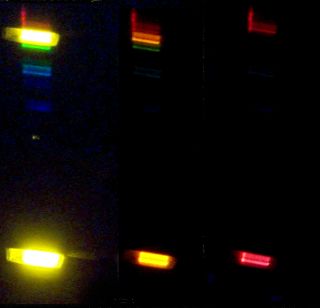
Plate 1a: Demonstrating the effect of Nonad (or another notch rejection filter) against the sodium D-lines. Showing the lamp and first order diffraction spectrum with 100%, 0.5% and <1ppm filter transmission. |
Plate 1b: An unshielded UK urban LPS street lamp showing internal details with and without filters.
Plate 1c: The same lamp through a dense Nonad filter. |
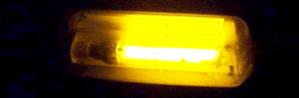
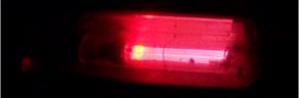
The standard 1960?s LPS street lamp has not been improved with ribbed glass and a crude fixture that allows around 30% of the light to go directly skywards. The lamps are so efficient that this wasn?t considered to be a problem when they were installed (Figure 1a,b).

|
Figure 1a sketch of light from a typical UK unshielded low pressure sodium lamp fixture. |
Figure 1b shows a Belgian shielded LPS fixture with full cut-off above the horizontal. |
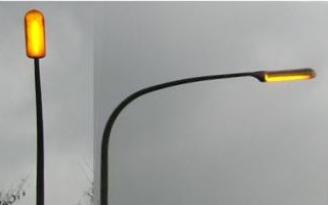
Belgian LPS fixtures are by comparison full cut-off designs with internal reflectors to control the light (Plates 2 & 3).
|
|
|
|
Plate 2:Typical urban Belgian shielded LPS street lamp face on and side elevation showing the full cut-off design with a semi cylindrical reflective aluminium shield around the lamp. |
Plate 3: motorway class Belgian shielded LPS street lamp on the and showing the onset of the cut-off shield. The lamp is a modern full cut-off design |
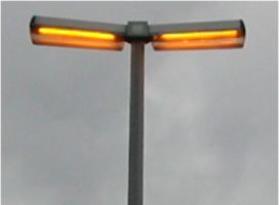
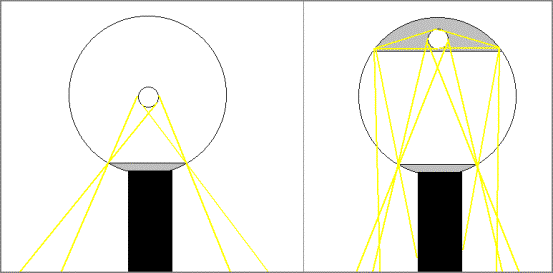
There are some very bad luminaire designs where more than half the light goes skywards. Typically used in supermarket car parks and appear to be designed to generate sky glow to attract passing trade. A classic bad design looks like a goldfish bowl with a lamp in on top of a vertical stalk (Figure 2).
|
Figure 2a the worst form of symmetric glass globe on a pole. These are typically found in supermarket car parks and send more than 60% of light skywards. Bad glare and no light at the base. |
Figure 2b shows how with a small amount of reflective mirror and a higher bulb position the light can all be directed downwards eliminating glare and the dark region underneath the pole. |
The other extremely bad design is the symmetric parabolic security lamp (500W quartz halogen). These have disastrous light spill and glare problems and there is no excuse at all for this ? asymmetric designs give better control, a more useful light distribution and vastly reduced glare (Figure 3).
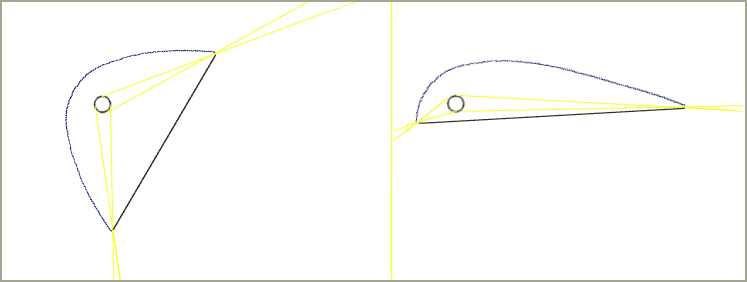
| Figure 3a shows a typical bad design of parabolic reflector lamp losing 25% of the light skywards | Figure 3b shows a good design of asymmetric parabolic reflector with full cut-off. |
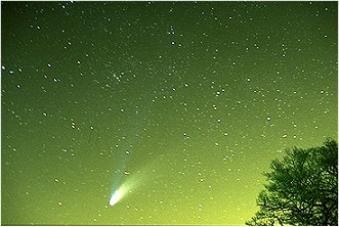
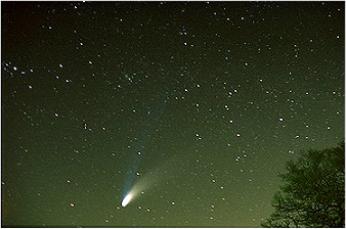
These sample images of Comet Hale-Bopp taken on 30/3/1997 from just south of Middlesbrough show the effectiveness of a notch reject filter against the sodium D-line for photography. The sky at low elevation here is visibly yellow to the naked eye.
Taken on Fuji 1600 ASA slide film 50mm lens f2 2 minutes exposure
|
|
|
|
Plate 4a: 2min exposure unfiltered 2212 UT |
Plate 4b: 2min exposure Nonad filtered 2215 UT |
Conclusion
To make astronomers happy:
- Use the right amount of light
- Light only the right places - shielded full cut-off fixtures are best
- Use the right type of light - low pressure sodium is easily filtered
Ideally we would like to see all new fixtures to match all these criteria. Wasted light is wasted money.
It would be nice to see some of the old inefficient luminaires retrofitted with inexpensive aluminium foil reflectors so that more of their light goes down onto the road instead of skywards.
References
1. Coaton, J.R. & Marsden A.M. , Lamps and Lighting 4 th edn., Arnold, 1997, London ISBN 0 340 64618 7 Wiley, 1997, New York ISBN 0 470 23589 6
2. Bradford, Connecticut lighting regulations http://selene-ny.org/downloads/lightfixtures.pdf
3. C. R. Benn, The Great Apagon http://www.dark-skies.freeserve.co.uk/cfds/apagon/apagon.htm
4. Sports lighting UK recommendations http://www.lighting4sport.com/lightpollution1.htm
5. US New York based site with other practical details http://selene-ny.org/