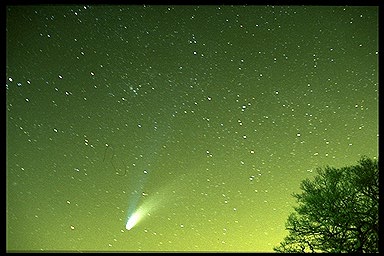
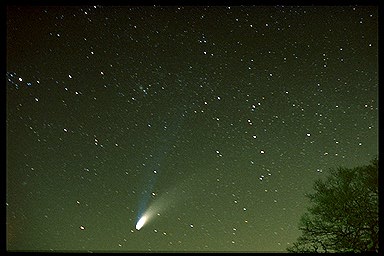
The Nonad filtered image digitally adjusted to equal gamma and background brightness of the unfiltered image.
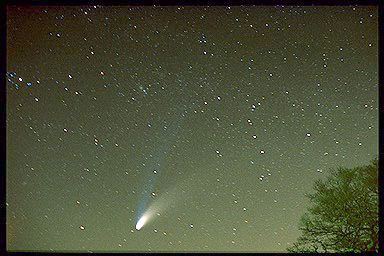
These pairs of images were taken back to back guided by an LX200 mounted in altaz mode. Stars near the edge of field show some rotation. Nonad images need about 1/2 stop extra exposure time to match unfiltered images for stellar magnitude. The scanned images to PCD have been converted to JPG files intended to look the approximately the same as the original slides.
Hale-Bopp on 30/3/97 50mm lens f2 2215UT unfiltered, 2212UT Nonad
filtered. Sky conditions were unusually clear even low to the horizon, and
although some light pollution was visible low down the comet was clear.
The Nonad filtered image digitally adjusted to equal gamma and background
brightness of the unfiltered image.
Hale-Bopp on 1/4/97, 50mm lens f1.4 note vignetting, 2300 unfiltered,
2310 filtered. Sky conditions were very poor and strong yellow light was
visible in the sky up to 30 degrees above the horizon reflected off thin
clouds. The comet was actually behind some thin cloud during both
exposures. I was simply trying to see what happened in these extreme
conditions. The unfiltered image is more like a yellow Y2 filter with a
burnt out overexposed region for the comet. Digital scanning did a
surprisingly good job of rescuing detail not otherwise visible to the eye
on the slide.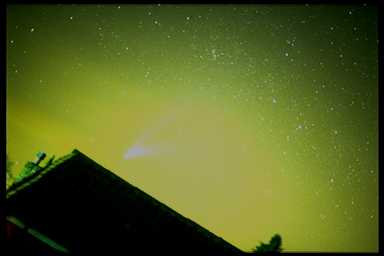
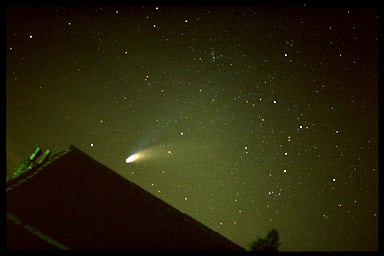
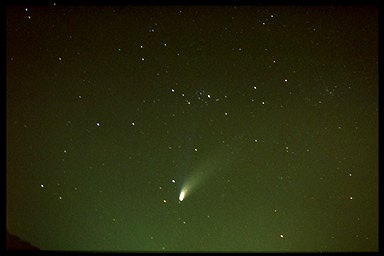
Hale-Bopp on 9/4/97, 50mm lens f2, 2224UT unfiltered, 2233UT filtered.
40s exposures Sky conditions here were characteristic of many nights in
the UK with some slight haze everywhere and a distinct yellow colour
visible near the horizon. A couple of aircraft con trails cross these
images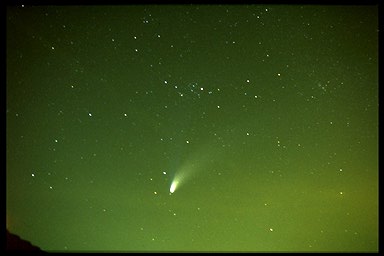
Return to main Nonad filter page or Spectra of LPS, HPS and Mercury street lights with and without light pollution filters.

